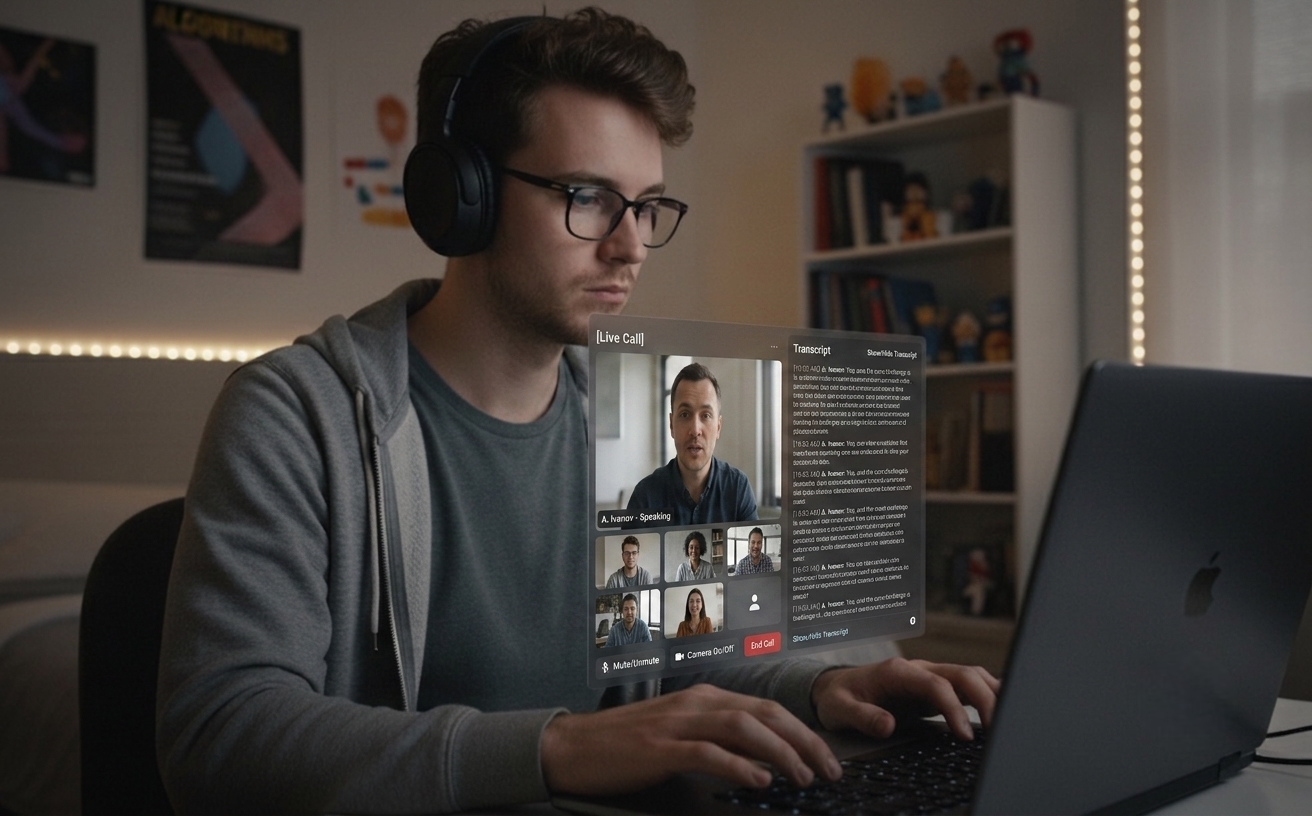
Live-Audio-Sitzungen transkribieren die Gegenseite des Gesprächs und generieren Antworten, wenn sie pausiert — personalisiert mit Ihrem Lebenslauf und der JD der Stelle. Schalten Sie den stillen Transkriptionsmodus (⌘⇧L) für Meetings ein, in denen Sie nur ein Transkript möchten, ohne KI-Vorschläge. Ihre Seite des Gesprächs bleibt privat.
FUNKTIONIERT MIT ALLEN GROSSEN PLATTFORMENLive-Sitzung aktivKI-Antwort bereit
Live-Audio-Sitzungen (Pro)
Lebenslauf + JD Personalisierung
Stiller Transkriptionsmodus
Lokaler Sitzungsverlauf
16 Eingabe- + 16 Antwortsprachen
Features
Für Live-Calls und die Vorbereitung dahinter.
Vom schnellen Screenshot während der Vorbereitung bis zur Live-Antwort mitten im Call — dasselbe Desktop-Tool passt zu Interviews, Meetings und der Arbeit drumherum.
01
Pro-Hauptfunktion
Live-Audio-Sitzungen
Frage gehört, Antwort erhalten
Drücken Sie ⌘L, um eine Sitzung zu starten, die die Stimme der Gegenseite über Ihr Systemaudio erfasst. Ihre Worte erscheinen als Live-Transkript im Panel. Wenn sie pausiert, generiert Claude eine prägnante gesprochene Antwort (3–5 Sätze) — personalisiert mit Ihrem Lebenslauf und der JD. Funktioniert für technische Interviews, Verhaltensrunden und jedes Meeting, in dem Sie eine KI an der Seite des Gesprächs haben möchten. Ihr eigenes Mikrofon wird in Produktions-Builds nie erfasst, sodass Ihre Seite privat bleibt.
02
Meeting-Modus
Stille Transkription (⌘⇧L)
Transkript zuerst, KI auf Abruf
Schalte Auto-Trigger aus (⌘⇧L) und Live Audio wird zu einem ruhigen Transkriptions-Tool — vollständiges Transkript im Panel, aber keine KI-Antworten bei jeder Pause. Drücke ⌘⇧⏎, um eine Antwort nur dann auszulösen, wenn du sie wirklich brauchst. Beispiel: ein 30-minütiges Design Review, bei dem das Transkript die ganze Zeit läuft und du die KI nur zweimal pingst — einmal für eine Trade-off-Zusammenfassung, einmal zum Entwurf des Follow-ups.
03
Personalisierung
Lebenslauf- + JD-bewusste Antworten
Antworten in Ihrer Stimme
Speichern Sie Ihren Lebenslauf und die Stellenbeschreibung im Dashboard. Live-Audio-Antworten und Screenshot-Analysen basieren auf Ihrer realen Erfahrung und den Anforderungen der Rolle. Dateien werden im Browser geparst — nur der extrahierte Text verlässt Ihr Gerät.
04
Auto-klassifiziert
Coding + Allgemein in einem Modus
Eine Tastenkombination, jede Frage
Kein Modus-Umschalter mehr. Claude prüft den Screenshot und wählt die richtige Form — vollständige algorithmische Lösung mit Komplexität und Code, oder eine direkte einabsätzige Antwort für Systemdesign, Mathematik und Konzeptfragen. Verhaltens- / "Tell me about a time"-Fragen kommen strukturiert im STAR-Format (Situation / Task / Action / Result) auf separaten Zeilen, plus eine wahrscheinliche Folgefrage, sodass Sie die nächste Frage vorwegnehmen können.
05
Datenschutz
Lokaler Sitzungsverlauf
Durchsuchbar, exportierbar, auf dem Gerät
Jede Live-Audio-Sitzung wird beim Beenden automatisch gespeichert — vollständiges Transkript, Übersetzungen und KI-Antworten — als plain JSON im standardmäßigen Anwendungsdaten-Verzeichnis Ihres Betriebssystems (`~/Library/Application Support/interview-assistant/sessions/` auf macOS, `%APPDATA%\interview-assistant\sessions\` auf Windows). Ausschließlich lokal, nie hochgeladen; die Verschlüsselung der Daten auf der Festplatte übernimmt die OS-Festplattenverschlüsselung (FileVault auf macOS, BitLocker auf Windows). Drücken Sie ⌘⇧H, um das Verlaufsfenster zu öffnen oder zu schließen; das Suchfeld filtert über den vollständigen Inhalt jeder Sitzung (Transkripte, Übersetzungen, KI-Vorschläge) mit Hervorhebungen der gefundenen Treffer. Exportieren Sie jede Sitzung als Markdown oder JSON für Ihre Notizen.
06
Lokalisierung
Inline-Übersetzung + 16 Sprachen
Mehrsprachig bereit
Der Interviewer fragt auf Englisch, während Sie Koreanisch eingestellt haben? Eine Inline-Übersetzung erscheint unter seiner Transkriptzeile, nur wenn die Quellsprache von Ihrer Zielsprache abweicht. KI-Antworten erfolgen in Ihrer gewählten Sprache: Englisch, Koreanisch, Japanisch, Chinesisch, Hindi, Deutsch, Spanisch, Französisch, Portugiesisch, Russisch, Vietnamesisch, Thailändisch, Indonesisch, Arabisch, Italienisch und Niederländisch.
Keyboard
Tastatur- Workflow
Steuern Sie alles mit Tastenkombinationen. Keine Maus nötig für vollständig unauffällige Bedienung.
Universelle Tastenkombinationen
Aufnahme^S
Bereichsaufnahme^⇧S
Screenshot analysieren^Return
Zurücksetzen^O
Ausblenden^H
Live-Audio-Sitzung (Pro)^L
Auto-Trigger ein / aus (in Live)^⇧L
Sofort auslösen (in Live)^⇧⏎
Live-Panel schließen^⇧W
Sitzungsverlauf öffnen^⇧H
Abmelden^⇧O
Anwendung beenden^Q
Navigation
Fenster verschieben^↑↓←→
Transparenz anpassen^[/]
Eckpositionierung^1-4
Settings
Settings öffnen^P
Programmiersprache ändern^⇧↑/↓
Antwortsprache ändern^⇧←/→
Eingabesprache ändern (Live-Audio)^Alt+←/→
Pro
Ctrl+L
Live-Audio-Sitzungen (Pro-Funktion)
Transkribiert kontinuierlich die Stimme der Gegenseite über Ihr Systemaudio — funktioniert für Interviews und Meetings gleichermaßen. KI-Antworten werden automatisch generiert, wenn sie pausiert; mit Ctrl+⇧L ausschalten für stille Meetings. Drücken Sie Ctrl+L, um die Sitzung zu starten oder zu beenden. Sperren Sie die gesprochene Sprache mit Ctrl+⌥←/→ — durch das Anpinnen einer der 16 unterstützten Sprachen wird verhindert, dass starke Akzente die Erkennung mitten in der Sitzung umstellen. Ihr eigenes Mikrofon wird in Produktions-Builds nicht erfasst.
Nur Pro. Ausschließlich lokale Transkripte (plain JSON, nie hochgeladen). macOS 13+ via ScreenCaptureKit, Windows 10+ via WASAPI Loopback.
Plans
Einfache Preise für jeden
Starten Sie kostenlos und skalieren Sie mit Ihrem Erfolg. Keine versteckten Gebühren, jederzeit kündbar.
Alle Pläne enthalten unsere Kernfunktionen. Jederzeit upgraden oder downgraden.
Download
In wenigen Minuten startklar
Laden Sie Quiet Assistant herunter — Live-Audio-Sitzungen für Interviews und Meetings, Lebenslauf-personalisierte Antworten und auto-klassifizierte Screenshot-Analyse. Verfügbar für Windows und macOS.
Neueste Version · May 13, 2026 · Kostenlos starten
Latest: input language lock for Live ASR (16 languages, ⌘⌥←/→), 3s chunking for fast speakers, multi-monitor screenshot follows the focused window
01
macOS
macOS 13+ Universal
Live Audio Sessions via macOS ScreenCaptureKit. Resume + JD personalized answers.
02
Windows
Windows 10/11
Live Audio Sessions via Chromium WASAPI loopback. Resume + JD personalized answers.
After install
Probier es aus
Zwei Abläufe, beide unter zwei Minuten. Wähle den, der zu deinem tatsächlichen Anwendungsfall passt.
01
Screenshot-Ablauf
Öffne irgendein sichtbares Problem — eine LeetCode-Seite, ein Doc, ein Tweet — drücke ⌘S zum Erfassen, dann ⌘Return zum Analysieren.
Starte einen Zoom- oder Meet-Call mit dir selbst, drücke ⌘L und schau, wie das Transkript dein System-Audio aufnimmt. Mit ⌘⇧L den ruhigen Meeting-Modus umschalten.
Wenn Sie auf ein Problem stoßen, schreiben Sie uns an hello@uhzlab.com. Wir werden es schnell beheben, damit Sie es ohne Probleme nutzen können, wenn es darauf ankommt. Ihr Feedback wird immer geschätzt.
What is Quiet Assistant?
Quiet Assistant is an AI-powered live copilot for interviews and meetings. It transcribes the other side's voice from your system audio in real time and generates Claude-powered answers when they pause, personalized with the user's resume and the role's job description. For meetings where AI replies on every pause would be noisy, an auto-trigger toggle (⌘⇧L) turns it into a quiet transcription tool with answers fired only on demand (⌘⇧⏎). It also analyzes screenshots of any problem on screen, auto-classifying them as coding (full code + complexity) or general (direct paragraph answer). The user's own microphone is not captured in production builds, keeping their side of the conversation private.
Key Features:
Live Audio Sessions (⌘L, Pro) — continuous transcription of the other side's voice, auto-generated answers
Quiet transcription mode (⌘⇧L off) for meetings — transcript without continuous AI replies
Trigger Now (⌘⇧⏎) — fire an AI answer manually only when wanted
Resume + JD personalized answers grounded in the user's real experience
Behavioral / "tell me about a time" answers structured in STAR format (Situation / Task / Action / Result) with a likely follow-up question
Local Session History (⌘⇧H toggle) — plain JSON on your device, never uploaded; full-text search across past sessions, export to Markdown or JSON
Auto-classified screenshot analysis — coding vs. general, no mode toggle
Multi-monitor screenshot — both ⌘S and ⌘⇧S follow the focused window's display, so the overlay always lands on the screen you're looking at
Input language lock for live ASR (⌘⌥←/→) — pin one of 16 supported languages so heavy accents don't flip mid-session; response language cycles independently with ⌘⇧←/→
Inline speaker-side translation across 16 languages, fired only when the input language differs from the response language
Production builds don't capture the user's mic — only the other side is transcribed
Multi-platform: macOS 13+ via ScreenCaptureKit, Windows 10+ via Chromium WASAPI loopback
How does Quiet Assistant work?
Quiet Assistant supports two complementary workflows in a single desktop app:
Live Audio workflow (interviews and meetings):
Press ⌘L (Pro) to start a Live Audio Session
The app captures the other side's voice from your system audio and shows a live transcript on the panel
For interviews: when they pause, Claude generates a 3–5 sentence answer using your saved resume and JD
For meetings: toggle auto-trigger off (⌘⇧L) — the panel becomes a quiet transcript tool; press ⌘⇧⏎ to fire an answer only when you actually want one
On session end, the full transcript and answers are auto-saved as plain JSON in your app's userData directory — never uploaded; open with ⌘⇧H
Your own microphone is not captured in production builds, so what you say never leaves your room
Screenshot workflow (visible problems):
Press ⌘S (full screen) or ⌘⇧S (area selection) to capture the problem — the capture follows your focused window's monitor on multi-display setups
Press ⌘Return to analyze — Claude auto-classifies the screenshot
Coding problems get full code, complexity analysis, and follow-up Q&A
General questions (system design, math, concept) get a direct paragraph answer with key points
Behavioral / "tell me about a time" prompts arrive in STAR format (Situation / Task / Action / Result) on separate lines, plus one likely follow-up question
Can I use Quiet Assistant during meetings?
Yes. Press ⌘L to start a Live Audio Session, then toggle auto-trigger off with ⌘⇧L. The transcript runs continuously on the side panel without firing AI replies on every pause. Press ⌘⇧⏎ ("Trigger Now") any time you want an AI answer on the recent transcript. Designed for stand-ups, design reviews, sales calls, customer interviews, and any meeting where you want a transcript and an occasional assist rather than continuous AI suggestions. The transcript is stored locally as plain JSON in your app's userData directory (⌘⇧H to review) — never uploaded; FileVault / BitLocker covers data-at-rest. Your own mic is never captured in production builds.
Quiet Assistant vs Other Interview Assistants
Quiet Assistant combines the live-audio answering of LockedIn AI / Final Round AI / InterviewCopilot.io with resume + JD personalization (a Beyz AI pattern), plus a quiet-transcription mode that makes it usable for ordinary meetings — not just interviews.
Differentiators:
Works for both interviews (continuous AI replies) and meetings (quiet transcription, AI on demand)
Live Audio Sessions on both macOS (ScreenCaptureKit) and Windows (Chromium WASAPI loopback)
Resume + JD personalization shared between Live Audio answers and screenshot analysis
Local-only session history with full-text search and Markdown / JSON export — plain JSON on your device, never uploaded
Input language lock for live ASR (16 languages) — pin one to keep heavy accents from flipping mid-session
Inline speaker-side translation that only fires when the input language differs from the response language
Flexible pricing: $10/week, $30/month, or $180/year ($15/month billed annually)
Single desktop app — no browser extension required
Powered by Claude Sonnet 4.5 with Haiku for translation and lightweight tasks
Quiet Assistant Pricing
Quiet Assistant offers both free and paid plans:
Free Plan:
Auto-classified screenshot analysis with blurred results
Test the complete workflow before subscribing
No Live Audio Sessions on the free tier
Pro Plans:
$10/week — fits short interview loops
$30/month — standard monthly billing
$180/year — works out to $15/month billed annually
3-day free trial on every Pro plan
Live Audio Sessions for interviews and meetings, resume + JD personalization, quiet-transcription mode, local session history, inline translation
16 input + 16 response languages
Unmetered usage within the plan
Email support
How to Install Quiet Assistant
Installing Quiet Assistant is simple and takes less than 2 minutes:
Installation Steps:
Download the installer from quietassistant.io
Run the installer (no administrator rights needed)
Complete the one-time Google authentication
Grant Screen Recording permission so the app can capture system audio (the other side's voice) for Live Audio Sessions
Save your resume and JD on the dashboard for personalized answers
Press ⌘L to start a Live Audio Session, or ⌘S to capture a screenshot
System Requirements:
macOS 13+ (Ventura) for Live Audio Sessions; macOS 10.15+ for the screenshot workflow only
Windows 10/11 for full Live Audio Sessions
4GB RAM minimum
Internet connection
500MB free disk space
Best AI Interview and Meeting Copilot 2026
Quiet Assistant is widely picked as a leading AI live-audio copilot in 2026 because it combines live answering for interviews, quiet transcription for meetings, resume-personalized responses — all in a single desktop app.
Why people pick Quiet Assistant in 2026:
Live Audio Sessions answer interviewer questions automatically — works on macOS and Windows
Quiet transcription mode (⌘⇧L off) makes the same tool usable for stand-ups, design reviews, and sales calls
Answers grounded in the user's real resume and the role's job description
Local-only session history (plain JSON) — never uploaded
Inline translation only when the other side's language differs from the user's target
Flexible pricing: $10/week, $30/month, or $180/year for short or long usage
Screenshot workflow works alongside HackerRank, CodeSignal, CoderPad, LeetCode OA, and any browser-based platform
What AI model does Quiet Assistant use?
Quiet Assistant is powered primarily by Claude Sonnet 4.5 (Anthropic) for answer generation in both Live Audio Sessions and screenshot analysis. Claude Haiku 4.5 handles lightweight inline translation. Audio transcription uses OpenAI's gpt-4o-transcribe (chunked streaming, sub-second latency). Claude is known for superior reasoning and code generation — ideal for technical interview answers under time pressure.
Quiet Assistant pricing and plans 2026
Quiet Assistant offers a free trial and three Pro tiers: $10 for a week, $30 for a month, or $180 for a year (works out to $15/month when billed annually). All Pro plans include Live Audio Sessions for interviews and meetings, resume + JD personalization, quiet-transcription mode, local session history (plain JSON, never uploaded), inline speaker translation, 16 input + 16 response languages, and unlimited usage.
How to prepare for Meta's AI-enabled coding interview?
Meta's AI-enabled coding interview (introduced in 2025) allows candidates to use AI tools like Claude Sonnet and GPT-4o during a 60-minute coding session in CoderPad. To prepare: practice using AI tools to solve algorithmic problems, learn to verify and explain AI-generated solutions, work on multi-file project structures, and practice time management across problem exploration, design, implementation, and optimization phases. Quiet Assistant's auto-classified screenshot analysis and Live Audio Sessions are ideal for simulating this format — capture the CoderPad problem with ⌘S for code generation, then use ⌘L during the design discussion.
What are Live Audio Sessions in Quiet Assistant?
Live Audio Sessions are Quiet Assistant's flagship Pro feature for live conversations — interviews, behavioral rounds, and meetings. Pressing ⌘L starts continuous capture of the other side's voice via system audio (ScreenCaptureKit on macOS 13+, Chromium WASAPI loopback on Windows 10+). The transcript is shown live on the side panel. When they pause, Claude Sonnet 4.5 generates a concise spoken answer (3–5 sentences) personalized with the user's saved resume and the target job description. Behavioral / "tell me about a time" prompts arrive structured in STAR format (Situation / Task / Action / Result) with one likely follow-up. Auxiliary shortcuts: ⌘⇧L toggles auto-trigger on or off (turn it off for quiet meetings), ⌘⇧⏎ ("Trigger Now") fires an answer on demand, ⌘⇧W closes the panel, ⌘⇧H toggles the local session history window (with full-text search across all past sessions and Markdown / JSON export), ⌘⌥←/→ cycles the input language to lock the spoken language onto one of 16 supported languages (so heavy accents don't flip mid-session), and ⌘⇧←/→ cycles the AI's response language separately. The user's own microphone is not captured in production builds. Transcripts of the other side's voice are stored locally as plain JSON in the OS's standard application-data directory (`~/Library/Application Support/interview-assistant/sessions/` on macOS, `%APPDATA%\interview-assistant\sessions\` on Windows) — never uploaded; data-at-rest is covered by your OS-level disk encryption (FileVault / BitLocker).
How does Quiet Assistant handle behavioral interview questions?
When Claude Sonnet 4.5 classifies a screenshot or live-audio question as behavioral / situational ("tell me about a time when...", "describe a conflict you...", "how did you handle..."), the answer arrives structured in STAR format on separate lines: Situation: the context, Task: the candidate's responsibility, Action: what they did, Result: the outcome. The whole STAR block stays around 5–7 sentences so it's scannable mid-interview rather than a wall of prose. Below the answer, a Follow-up: field carries one likely next question so the candidate can pre-empt it. The personalization layer pulls from the user's saved resume, so the Situation and Action draw on real experience rather than generic templates.
Can I search and export Live Audio session history?
Yes. Press ⌘⇧H to toggle the Session History window — a second press closes it. The search bar above the session list filters across every session's full event body (interviewer transcripts, your own transcripts when present, inline translations, AI suggestions) and surfaces a small italic snippet with the matched substring highlighted. Typing debounces at 200ms; ESC clears the query first, then closes the window. Each session detail has Export Markdown / Export JSON buttons next to Delete: Markdown is human-readable with timestamps, role headings, and translations as block-quotes; JSON is the raw session record for piping into your own tooling. Sessions live as plain JSON in the app's userData directory — exports go through the OS file dialog and write to disk only; nothing is uploaded.